

Program Structure and Duration
The Cardiovascular Disease Fellowship is a 36-month ACGME accredited training program structured into thirteen four-week blocks per academic year. The curriculum is designed to provide comprehensive exposure to inpatient and outpatient cardiovascular care, procedural and nonprocedural cardiology, and progressive responsibility across all three years of training.
Rotations are organized to ensure distributed and longitudinal exposure to all core cardiovascular disciplines while avoiding front-loaded or episodic experiences. Fellows progress from supervised participation to independent clinical decision-making and teaching roles by the end of training.
Continuity Clinic
All fellows participate in a longitudinal continuity cardiology clinic throughout all three years of training. Fellows attend a minimum of one half-day weekly, regardless of block rotation assignment, with protected time ensured during inpatient, critical care, and laboratory rotations. The continuity clinic provides ongoing responsibility for longitudinal patient care and reinforces outpatient cardiovascular management.
Year 1: Foundational Clinical and Procedural Training
The first year emphasizes foundational skills in acute cardiovascular care, noninvasive imaging, invasive cardiology, and consultative cardiology practice.
Year 2: Skill Advancement and Increased Clinical Responsibility
The second year builds on foundational skills, emphasizing increased independence, procedural advancement, and initiation of scholarly activity.
Year 3: Advanced Training, Leadership, and Teaching
The third year emphasizes advanced clinical judgment, procedural exposure, leadership, and preparation for independent cardiology practice or subspecialty training.
Vacation
Fellows are provided up to four weeks of vacation annually, taken during designated rotations in a manner that does not compromise required clinical experiences or continuity clinic participation.
Educational Outcomes and Oversight
The curriculum ensures fellows meet or exceed ACGME and COCATS Level I requirements for general cardiology training. Progression is monitored through direct observation, procedural logs, milestone evaluations, and faculty feedback. The structured rotation design supports clinical competence, scholarly activity, and professional development.
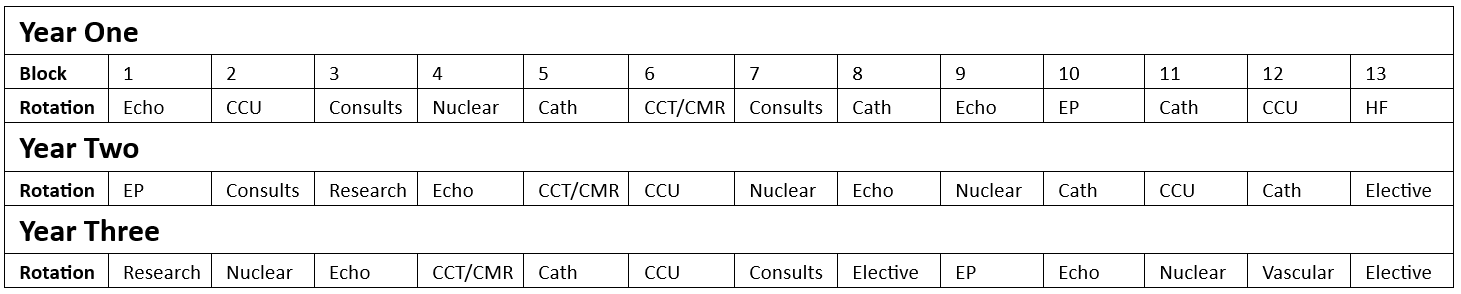
Block Schedule
1 block = 4 weeks (13 blocks/year)
Notes:
CCT: Cardiovascular CT; CMR: Cardiovascular Magnetic Resonance
Electives will be tailored to fellows’ interests and clinical training requirements; Electives include Advanced heart failure, CV surgery, CCT, CMR, Nuclear (including PET), Echocardiography, Cath, EP, and Clinical Research. Additional electives including pediatric cardiology, women's health, cardio-oncology, vascular medicine, AI in CV, Medicine and others can be requested in consultation with the program director.
Vacation time is scheduled in accordance with institutional policy and does not replace required clinical experiences; all fellows meet required rotation durations despite vacation usage. Recommended blocks for taking vacation time off include Nuclear, Cath, CCT/MR, Echo. Approval of PD/APD is required for vacation time off.