

June 25, 2026
When most people think of mammograms, they think about breast health. But what if these routine screenings could offer insights beyond detecting breast cancer? Could your mammogram also identify your risk for heart disease? A research team from Valley Health System set out to answer that question, evaluating the association between cardiovascular disease and breast arterial calcifications (BAC), calcium deposits that form in the walls of the arteries of the breast.
Screening Mammograms
Most are familiar with the national guidelines recommending average-risk women begin screening mammography at age 45. A screening mammogram is a preventive exam used to detect early signs of breast cancer.
Results from a screening mammography will provide the patient with the following:
- Findings: Whether there are any cancerous or benign findings, including cysts or lesions,
- Breast density: The amount of fibrous and glandular tissue in the breasts compared to fatty tissue,
- BI-RADS category: A standardized reporting score used to describe the level of findings on a mammogram and guide next steps, and
- Follow-up recommendations: Recommendations for follow-up care or additional imaging.
Screening mammograms may also reveal incidental findings, or unexpected abnormalities not related to breast cancer, such as breast arterial calcifications. These calcifications are not a sign of breast cancer, but they can be associated with an increased risk of heart disease. Despite serving as a potential marker for heart health, BACs are not routinely reported on screening mammography results.
The Study
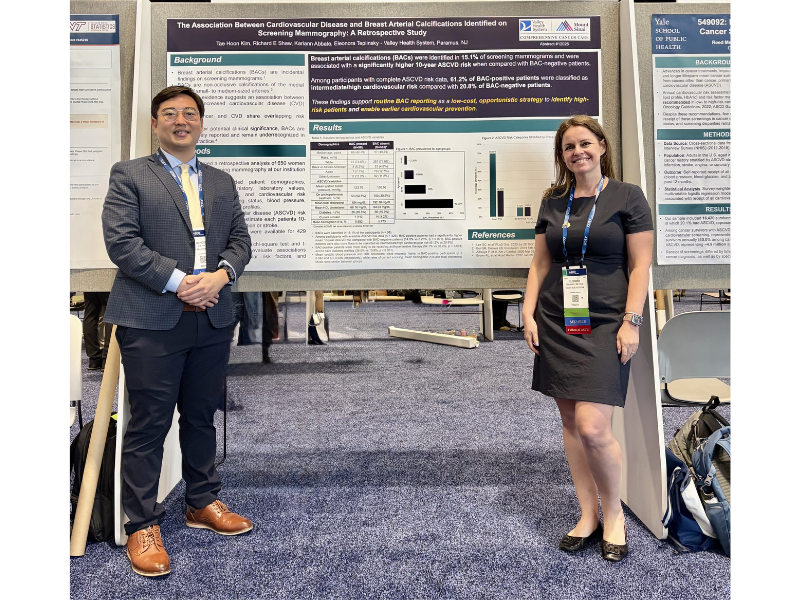
A research team from Valley Health System sought to underscore the correlation between BACs detected during a screening mammogram and a patient’s risk of heart disease. Together, Tae Hoon Kim, MD, internal medicine resident; Kariann Abbate, MD, Director of the Advanced Heart Failure and Recovery Program at The Valley Hospital; and Eleonora Teplinsky, MD, Head of Breast and Gynecologic Medical Oncology at Valley-Mount Sinai Comprehensive Cancer Care, completed an analysis of 650 women who had a screening mammography performed at Valley Health System.
Using laboratory values, and known cardiovascular risk factors, such as smoking status, blood pressure, diabetes, and lipid profile, the team calculated atherosclerotic cardiovascular disease (ASCVD) risk scores to estimate each patient’s 10-year risk of having a cardiovascular event, such as heart attack or stroke.
The findings of this study were presented during the 2026 American Society of Clinical Oncology (ASCO) Annual Meeting, a conference gathering cancer researchers, clinicians, patient advocates, and industry leaders to explore advances in cancer care.
“The results of this study were consistent with the anticipated outcomes. Breast arterial calcifications were identified in 15.1% of the 650 screening mammograms reviewed,” said Dr. Kim.
“Patients with BACs were associated with having a significantly higher 10-year ASCVD risk score, when compared to patients who did not have BACs detected, highlighting the increased risk of future heart disease. Of the patients identified as having BACs, 61.2% were classified as having intermediate/high cardiovascular risk compared to 20.8% of patients who did not have BACs,” Dr. Kim continued.
What Does This Mean for Patients?
Heart disease is the leading cause of death for women in the United States, responsible for nearly 1 in every 5 female deaths in 2023, as reported by the Centers for Disease Control and Prevention.
“Women face an often-under-recognized risk of heart disease,” said Dr. Abbate. “The results from our study identify breast arterial calcifications as an opportunity to report on heart health while also reporting on breast health after a screening mammography is performed. This research supports the thinking that patients will no longer need two separate tests to review their breast health and heart health.”
“Screening mammography offers a unique opportunity to look beyond breast cancer detection. These routine images can also give us valuable insight into a patient’s cardiovascular risk,” said Dr. Teplinsky. “By recognizing this dual benefit, we can turn a single, widely adopted screening tool into a more comprehensive screening approach for women’s health.”
“Given the overwhelming evidence demonstrating the link between the presence of breast arterial calcifications and increased risk for coronary artery disease and stroke, we will now be reporting the presence or absence of BACs in our screening and diagnostic mammography reports,” said Elina Zaretsky, MD, Director of Breast Imaging at The Valley Hospital.
Reporting breast arterial calcifications on screening mammograms will help serve as an indicator of cardiovascular risk and provide patients with the knowledge needed to better understand their risk of cardiovascular disease. For those patients who are diagnosed with BAC, referrals to cardiologists for preventive heart care will be provided.
Is it Time for Your Mammogram?
Regular mammograms are an important part of overall health and wellness. Take charge of your health by scheduling your mammogram today at one of Valley’s four convenient locations – in Mahwah, Montvale, Paramus, and Ridgewood.
To schedule online, please visit ValleyHealth.com/Mammogram or call 201-447-8200 if you prefer to schedule over the phone.