

Through the use of robotic surgery, surgeons at The Valley Hospital’s Institute of Robotic Surgery can offer a minimally invasive alternative to complex open surgeries. This technique allows surgeons to operate through the smallest of incisions, offers greater precision, and brings significant benefits to patients.
Why Choose Valley for Robotic Surgery?
- A robotic surgery pioneer. In 2001, Valley was among the first hospitals in the country to adopt the first da Vinci® Surgical System for minimally invasive surgeries. Valley continues to invest in next-generation robotic systems — including the Mako Robotic-Arm Assisted Surgical System for partial knee, total knee and hip replacements — to bring the latest minimally invasive options to patients. Valley’s surgeons receive extensive training in robotic surgery techniques.
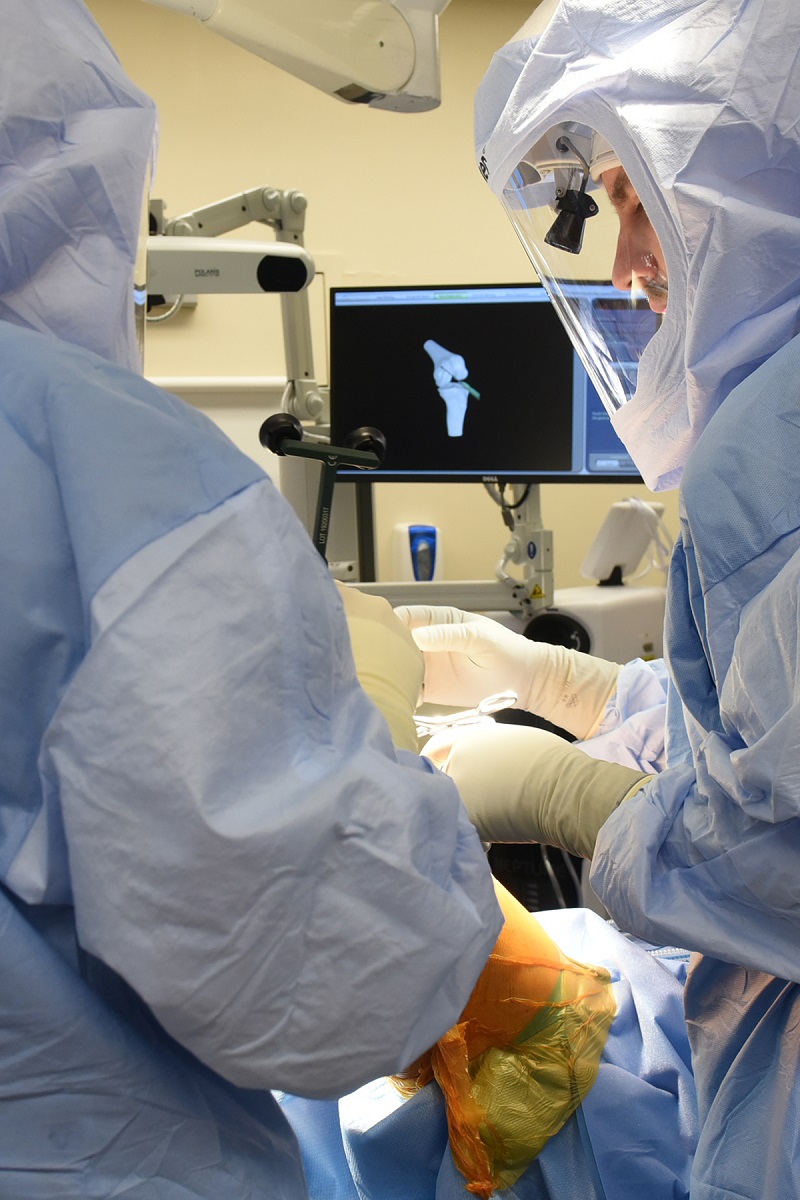
Orthopedic surgery using the Mako Robotic-Arm Assisted Surgical System Unmatched precision. Thanks to high-definition 3-D visualization tools, personalized surgical plans, intuitive motion and ergonomic design, robotic surgery enables surgeons to perform even the most complex and delicate procedures through very small incisions with outstanding precision.
- Impressive patient benefits. Robotic surgery offers several advantages over open surgery, including significantly less pain, reduced blood loss, less scarring, a shorter recovery time, a faster return to normal daily activities and, in many cases, better clinical outcomes. Early recovery is especially important for patients undergoing cancer treatment, as it may mean an earlier transition to the next stage of treatment. Open surgery, meanwhile, requires at least a month before the next phase of treatment can begin.
Conditions Treated
- Acid reflux and GERD (Nissen fundoplication, hiatal hernia repair)
- Adrenal tumors (adrenalectomy)
- Benign gynecological issues (total/partial hysterectomy, salpingo-oophorectomy, myomectomy)
- Colorectal cancer (colectomy, low anterior resection)
- Esophageal cancer (esophagogastrectomy)
- Gallbladder treatment (cholecystectomy)
- Incontinence (stress sacrocolpopexy)
- Joint replacements — partial knee, total knee and hip
- Kidney cancer (nephrectomy, nephroureterectomy, reimplantation of ureters)
- Liver cancer (hepatic lobectomy)
- Lung cancer (lobectomy, wedge resection, VATS)
- Mediastinal tumors (mediastinal tumor resection)
- Obesity issues (sleeve gastrectomy, gastric bypass)
- Pancreatic cancer (Whipple procedure, distal pancreatectomy)
- Prostate cancer (prostatectomy)
- Spleen conditions (splenectomy)
- Stomach/gastric cancers (gastrectomy)
- Uterine cancer and benign fibroids (total hysterectomy, salpingo-oophorectomy, myomectomy)


